
ATELIER YINPRESSION
Fine Art latin Calligraphy by Ying

Welcome to the treasury of historical letterforms.
This guide traces the beautiful evolution of Western calligraphy.
You will journey from ancient Roman stone carvings to medieval manuscripts.
Take your time wandering through these timeless shapes.
*While the scripts are generally listed in order of the time they were used, different scripts may have developed simultaneously in different regions, so please understand that history cannot be represented by a single simple line.
*There is also a list of scripts that are only used in palaeography.

This easy-to-read script was initially used for inscriptions carved on walls and monuments, but its excellent balance has led to its continued use in various situations today.
The inscription on the base of Trajan's Column, AD 107~113
roman capital
_edited_edited_edited.png)
modern, by Ying
It is known as square capital because of its almost square proportions and significant width in relation to its height. This script was written on paper using a reed pen, in contrast to Roman capitals, which are frequently carved into stone. Although it is a formal script, Roman capitals are a little more formal. Writing this script takes a lot of time because the pen point needs to be held at 0° horizontally and involves precise angle adjustments and pen manipulation.
square capital
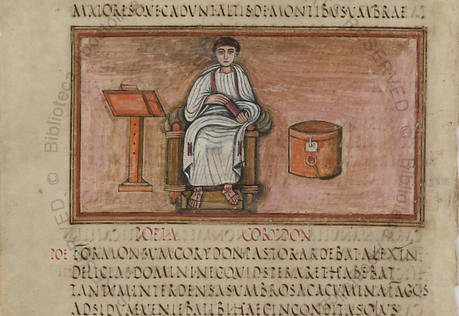
'Rustic' means country-style. Often written with a brush. It is regarded as a more informal script than Roman capitals and square capital.
The Vergilius Romanus, f. 3r
rustic capital

The British Library Board, Papyrus 229.
Roman cursive can be divided into two styles:
old Roman cursive and new Roman cursive. Old Roman cursive was used from approximately the 1st to the 3rd centuries and is considered a majuscule script, while new Roman cursive appeared after the 3rd century and, unlike old Roman cursive, was considered a minuscule script. It influenced Insular minuscule and Merovingian script later. The most widely used script was Roman cursive, which was mostly written on papyrus and only a few texts have survived.
roman cursive

modern, by Ying
The term "uncial" is believed to mean "inch". One theory suggests it was named this way because the script was typically about one inch in height (2.54 cm), though there are not many manuscripts that confirm this size. The exact origin of the name remains unclear. Uncial is a rounded script that developed in North Africa between the 2nd and 3rd centuries and is thought to have been influenced by Greek script. The script plays an important role in the history of calligraphy. Many important texts have been passed down in this writing.
*The Prologue of Saint Jerome to the Book of Job
habeant qui volunt veteres libros, vel in membranis purpuris auro argento que descriptos, vel uncialibus, ut vulgo aiunt, litteris
uncial

the Ceolfrid Bible
artificial uncial
This script requires precise pen control, as the nib maintains a 0 ° angle. Although it superficially resembles square capitals, it is actually a variation of uncial script, which means that many of the letters are rounded.
If you're unsure whether to judge artificial uncial or square capitals, you can easily tell the difference by looking at the shape of the 'M' and 'E'. Artificial Uncial follows the uncial, so both the 'M' and 'E' are rounded, while square capital, a Roman script, has square 'M' and 'E'.

the Lindisfarne Gospels, Cotton MS Nero D IV, f. 40r
Also known as "half uncial" or "irish majuscule," this script features rounded letters that are written slowly and carefully, resulting in clearly defined characters. However, some letters may be challenging for modern readers to decipher. This script is typically used in luxurious manuscripts.
insular majuscule
r%E3%80%80%E6%8B%A1%E5%A4%A7.jpg)
This script is very hard to read because of its long ascenders and descenders, along with many similarly-shaped letters and numerous variations and ligatures.
Book of Armagh, f. 154r
insular minuscule

Lectionnaire de Luxeuil, f. 9v
The provinces gained authority when the Roman Empire started to fall apart, and each region's language and writing system evolved separately. The Merovingian script developed in this context. It is one of the hardest scripts to read because of its close spacing, many ligatures, and variants. It was widely employed in the Merovingian dynasty of the Frankish Kingdom. It is distinguished by quick, erratic strokes and a high X-height.
merovingian script

The British Library Board, Add. 11695, f. 194r.
The script used in the Iberian Peninsula from the 7th to the 13th centuries developed from half-uncial and Roman cursive script. It had two different styles: one was a meticulously written bookhand, and the other was a cursive style designed for quicker writing. This script was also referred to as 'littera toletana' in the past. The rise of the Carolingian script eventually led to its decline.
visgothic script

This script was used in southern Italy. An eighth-century manuscript found at the Abbey of Monte Cassino has the first known example of this script. It is thought that the name "Beneventan" comes from the mediaeval duchy "ducatus Beneventanus," not from the city. It evolved from the Roman Cursive script and is distinguished by its unique 't' ligature and 'a' shape, which resembles two 'c's linked together.
The British Library Board, Add. 30337, f. 8r.
Beneventan script

TheMoutiers-Grandval Bible f. 7v
The Carolingian minuscule was developed during the time of Charlemagne. The various regional scripts that emerged, such as Insular minuscule and Merovingian script, were often challenging to read. As a result, it was designed to produce a more readable script. This minuscule was the first script to be widely used in Western Europe after the collapse of the Western Roman Empire. It continued to be used for a long time afterwards, greatly influencing later generations, including humanists and foundational hand.
caroline minuscule/
carolingian minuscule

The St Albans Psalter
Emerging in the 12th century, this script represents a transitional phase in the gradual effort to compress letters horizontally in order to save valuable parchment. Before evolving into Gothic script, it was somewhat narrower than Caroline script but still retained a degree of roundness and was slightly wider than the typical Gothic script known as Gothic textura. Additionally, it is the first script to use both capital and lowercase letters, and it is also referred to as Early Gothic script.
Protogothic script

Among the many Gothic scripts, Gothic Textura serves as a representative one. The characteristics of the script are diamond-shaped serifs at the start and finish of strokes. It is called Textura because, when viewed from a distance, letters give the impression of woven fabric. It is also referred to as Gothic Quadrata, Textualis Quadrata, and black letter.
The British Library Board, Bible Liege, about 1430
gothic textura/
textualis quadrata/
black letter

The name refers the lack of feet. This script characteristic is that the bottoms of the vertical strokes of letters are finished off square, without any feet. These shapes required several strokes of a technique called pen manipulation. This meticulous process contributes to its use in adorned manuscripts, where every stroke and detail adds to the overall splendour of the text.
The British Library, Add MS 42130, the Luttrell Psalter, f. 202v
gothic textura prescissa/
textura prescisus

The British Library, Harley 4431, 'The Book of the Queen' f.135
As the term "cursive" suggests, this script is usually composed quickly. The strokes are joined, writing the text requires little pen lifting. While it shares many characteristics with the Bastarda script, Gothic Cursive—being intended primarily for everyday use rather than for high-end manuscripts—was often written more rapidly and tends to feature a slight rightward slant. Furthermore, loops are often used to connect letters.
gothic cursive

BnF, français 273, Décades de Tite-Live, fol. 11v
gothic bastarda
The word "Bastarda" suggests a hybrid nature; the script was given this name because it blends the features of a cursive-like hand, which is quicker to execute and more appropriate for daily use, with those of Gothic script, which takes a long time to create.
While it closely resembles Gothic Cursive, the Bastard script features fewer connecting strokes and requires the pen to be lifted more frequently for careful execution. As a result, it is featured in many elaborately illuminated manuscripts rather than practical applications like commerce. Nevertheless, it is frequently challenging to tell it apart from Gothic Cursive; British palaeography and continental palaeography would have different opinions on this debate.

British Library, Add. Ms.34294, The Sforza Hours
Although it is a Gothic script, it differs from Textura by not significantly compressing character widths; instead, it is characterised by a combination of straight lines and rounded curves. One theory suggests it originated in Italy by purposefully fusing the rounded Carolingian style with the Gothic Textura, which is popular in Northern Europe. It was especially used in Italy and the Iberian Peninsula, and it was a popular choice for hymn sheet music because the letters are wide and the lines are clear, even when viewed from a distance.
gothic rotunda

modern, by Ying
Italic is characterised by a slight rightward tilt, a result of being written quickly. Additionally, there is a non-slanted italic version that is more suitable for formal writing. It became prevalent in the Chancellery of Italy and is commonly referred to as 'chancery'. There are many variations, and it spread throughout Europe. It is also noted that Queen Elizabeth I of England was learning about this script.
italic

Bibliothèque nationale de France, Livre d’écriture représentant naïvement la beauté de tous les caractères financiers mainten by Louis Senault, p. 5
ronde
This script was popularised by Louis Barbedor in the 17th century. Although influenced by gothic bastard, its rounded style gained popularity and spread widely; in France, it was adopted for teaching handwriting to elementary school students until the 20th century. It was refined in Germany during the 19th century, where it was sometimes called Deutsche Rundschrift (German Roundhand). A characteristic of "German Roundhand" is to keep connecting letters from bottom-right to top-left with thin lines and disregard for stroke order in favour of consistency; in contrast, the 17th-century French version focus on natural pen movement for connections, meaning not every letter was linked.

It was a cursive script developed for record-keeping in royal and ecclesiastical courts. Especially used in English legal documents. George Bickham's The Universal Penman has a template for this script. It was officially abolished in 1731.
Example from Andrew Wright's Court Hand Restored
court hand
References
Patricia Lovett, The Art and History of Calligraphy, The British Library, 2017
Julien Chazal, Calligraphie-le Guide complet, Groupe Eyrolles, 2012
Claude Mediavilla, Calligraphie, Imprimerie nationale, 1993
Editd by Frank T. Coulson and Robert G. Babcock, The Oxford Handbook of Latin Palaeography, Oxford University Press, 2020